
3D Model Readiness Prototype
An AI-assisted Three.js prototype for checking basic model properties before real-time web use.
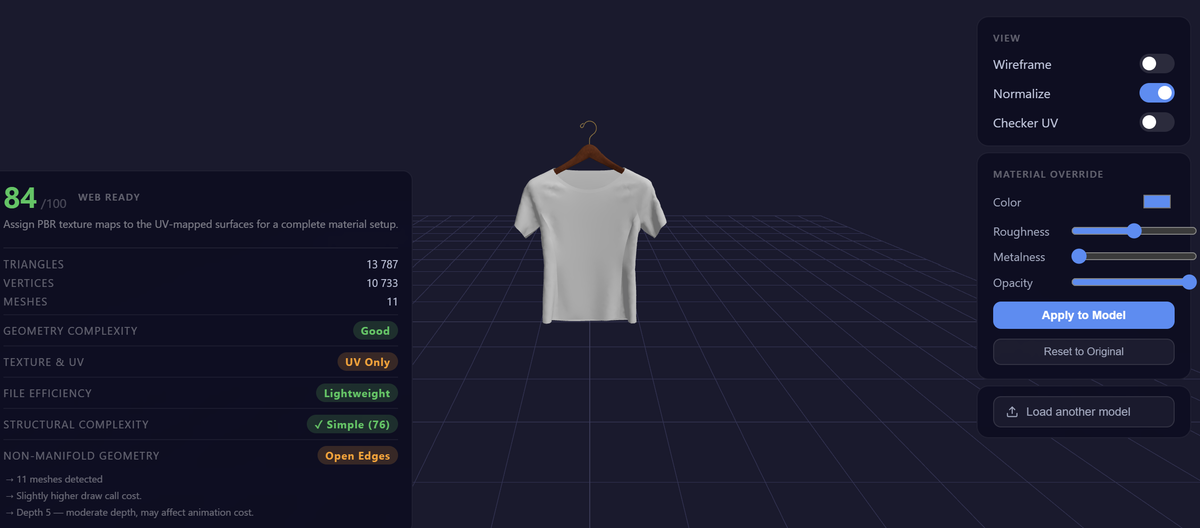
Independent, AI-assisted Three.js project
This project explores how a browser-based tool could help 3D creators check basic model properties before using an asset on a real-time website.
The challenge
Models prepared for visual quality may contain more geometry than a website needs. Incorrect pivot placement, unexpected positioning or missing UV and texture-map data can also create problems when an asset is handed over.
The goal was to bring these basic checks into one simple interface.
The prototype checks
- Polygon count against the threshold defined in the prototype
- Whether a UV map or texture map exists
- Pivot placement
- Whether the model is in the expected position
The tool reports these properties to help the user identify areas that may need attention. It does not judge UV quality or guarantee that a model is production-ready.
My contribution
I developed the concept, decided which model properties the prototype should inspect and created the models used for testing.
AI was used to generate the Three.js code based on my requirements. I guided the development through repeated testing and adjusted the requirements when the results did not behave as intended.
Testing
I created models with different geometry counts and setup conditions, loaded them into the application and compared the reported results with their known properties.
The prototype has only been tested by me. It has not been validated by other users or used in a production workflow.
Outcome
The result is a working personal prototype that demonstrates how basic 3D model information can be presented in a browser before real-time web use.
The project helped me explore how 3D production knowledge can be translated into a practical checking experience while also learning how to define, test and refine an AI-assisted technical solution.
Limitations
- Testing has only been completed by me.
- Polygon thresholds are prototype settings rather than validated production standards.
- The tool checks whether UV or texture-map data exists, not its quality.
- Pivot and position requirements may differ between workflows.
- The results do not guarantee website performance or production readiness.
- The AI-generated code has not been reviewed for production use.